The Jackbox Party Pack
- 2.7
- Rating
- 10.00K
- Installs
- $24.99
- Price

 Analysis by App-foxy
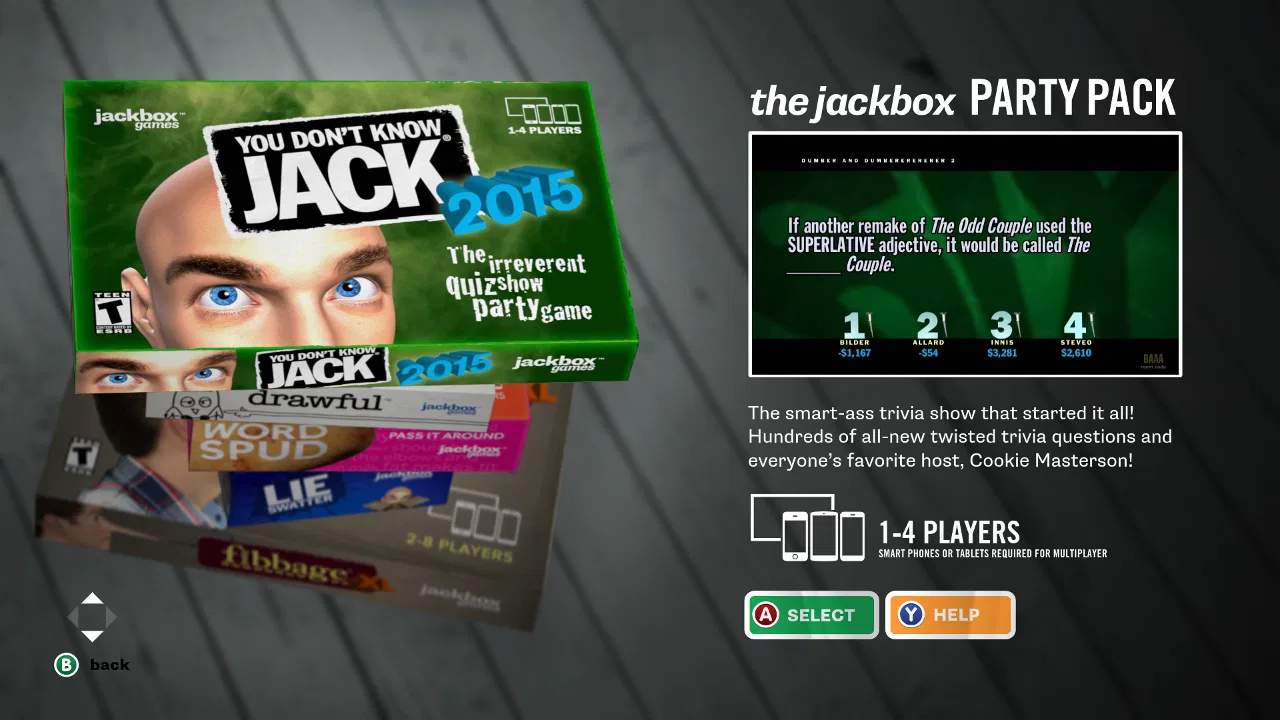
I approached The Jackbox Party Pack as the sort of game you bring out when a normal board game feels too formal and a room full of people needs an easy reason to laugh. It is a trivia-focused party game from Jackbox Games, Inc., built around using phones or tablets as controllers rather than handing everyone a traditional gamepad. That simple idea remains its biggest strength: people can join from the device they already have, while the main screen keeps the group focused on the action.
My overall impression is mixed but fairly clear. When the right group is together, the pack can turn a quiet evening into a lively one with very little preparation. It is especially comfortable for friends who enjoy silly answers, quick reactions, and playful competition more than serious quiz accuracy. At the same time, the purchase is harder to justify for someone who mainly wants a deep solo trivia experience or a large, constantly changing collection of questions. The average rating of 2.7 from roughly forty ratings reflects that this is a product with a specific audience rather than a universal party recommendation.
How the pack feels in a real living-room session
The most useful way to understand this game is to imagine a normal evening rather than a store page. A few friends arrive, someone connects the game to the television or another shared screen, and each person uses a phone or tablet to participate. Nobody needs to learn a complicated control scheme before playing. That low barrier matters because party games often lose energy when one person has to explain menus, buttons, or rules for several minutes.
You May Also Like

 Blood Strike: 2.5 Anniversary
Blood Strike’s Loadouts Turn Every Drop Into a Tactical Gamble
A close look at Blood Strike’s custom loadouts: how fast access to signature weapons reshapes its battle royale rhythm, rewards preparation, and narrows the gap between fights.

 Pandora - Music & Podcasts
Pandora’s Music Is Easy to Start, but Harder to Recover
Pandora’s strength is its low-effort path from a seed to a station. Its weak spot is how much confidence it asks you to place in connection, setup, and quiet recovery.

 8 Ball Pool
 Is Built on Rivalries, Rematches, and Routine
A close look at the rivalries, rematches, shared routines, and unanswered safety questions that turn a quick pool match into a persistent mobile community.

 Samsung Music
’s Quiet Strength Is Playing What You Already Own
Its reach comes less from spectacle than from dependable access to a personal library. That simplicity is both the app’s strongest retention engine and its ceiling.

 AccuWeather: Weather Radar
AccuWeather Review: A Quick, Clear Forecast for Everyday Decisions
For everyday plans, the best forecast is the one you can understand quickly. AccuWeather makes rain timing, radar, and local conditions easy to act on, with a few trade-offs.

 Hill Climb Racing
Why Hill Climb Racing Still Turns Crashes Into One More Run
A tiny car, a bumpy hill and one more upgrade: Hill Climb Racing keeps resurfacing because its simple chaos makes every near-miss feel personal.
More From Our News Desk
View All News


I would use it after dinner, during a casual gathering, or at a family event where the players are old enough for its Teen content rating. The game works best when everyone is willing to answer with personality instead of treating every question like a formal examination. The humor comes from the group reacting to answers, noticing patterns in how friends think, and enjoying the occasional ridiculous result.
That also explains why the experience can vary so much from one household to another. A group that likes improvisation and teasing will probably get more out of it than a group that wants precise scoring and quiet concentration. I would not buy it expecting a traditional quiz app with a clean question bank and a serious learning purpose. Its trivia foundation is there, but the social performance around each answer is the real attraction.
Phones make joining easy, but the main screen still matters
Using phones as controllers is convenient, yet it does not make the game independent of a shared display. The group needs to see the central presentation clearly, because that is where the prompts, reactions, and results become meaningful. Before starting, I would check that everyone can comfortably see the screen and has enough battery for a full session. A small screen across a large room can weaken the jokes and make people look down at their own devices instead of watching one another.
There is a useful social distinction here. The phone is mainly an input tool, not the place where the whole experience happens. That helps shy players participate without holding a controller in front of them, but it also means the game is less appealing if everyone is scattered in different places. In that situation, an ordinary mobile trivia game may be more practical because each person can play independently on their own screen.
I also recommend deciding who will handle setup before the guests arrive. The person connecting the game should not be trying to troubleshoot while the rest of the room waits. Once the session is ready, the controls are approachable; the awkward part is usually the transition from conversation to the first round, not the act of submitting an answer.
Why the pack works better with personalities than with perfectionists
The strongest moments are not necessarily the moments when the smartest player wins. They come when an answer reveals something unexpected about a friend, when several people interpret a prompt in completely different ways, or when a confident guess falls apart. That makes the game a good fit for mixed groups with different levels of trivia knowledge. A player who would avoid a conventional quiz can still contribute through timing, creativity, and a willingness to commit to an answer.
On the other hand, players who dislike public mistakes may feel exposed. Even though everyone uses a personal device, the results become part of the group conversation. I would avoid introducing it as a test of intelligence. Framing it as a relaxed party activity makes a noticeable difference, particularly with guests who are unfamiliar with Jackbox-style games.
For a small gathering, the energy depends heavily on whether people comment between turns. If everyone answers silently and waits for points, the pack can feel thinner. If the room discusses the wording, predicts what others will choose, and celebrates strange answers, the same content becomes much more entertaining. That is an important trade-off: the game supplies a structure for the party, but the players supply much of the atmosphere.
What the release history tells me about its current place
The game was released on December 23, 2014, and its current version is 1.1.1. Those details place it firmly in an older generation of party software. I do not see that age as an automatic problem. A well-designed group game can remain useful for years because its value comes from the people playing it, not from visual novelty. Still, I would approach it as an established pack rather than a newly evolving service.
The minimum operating-system requirement is Android 4.0, which is an unusually broad baseline by modern standards. That can be helpful when a group includes older phones or tablets that would struggle with newer applications. It also signals that the technical foundation is not demanding. In practical terms, the bigger question is likely to be the condition of the shared display and the reliability of the local setup rather than raw device power.
The version number is useful context, but it should not be treated as proof of a major redesign. I would not assume that a version update turns an older party pack into a modern, continuously refreshed platform. The safer expectation is a fixed entertainment purchase that people return to when they want this particular collection of games.
What has changed, and what that means for buyers today
The confirmed release and version information show that the product has had a long life, but they do not justify promises about a dramatic feature expansion. That distinction matters because party-game buyers sometimes expect new questions, seasonal events, or ongoing content simply because an app remains available. I would evaluate this pack for what is present now, not for an imagined future update.
For an existing owner, the current version can be viewed as the reference point for compatibility and everyday use. If the game already works well on the intended device, there is little reason to think of it as a constantly changing experience. The benefit is predictability: you can learn the rhythm of the pack and bring it back for different groups. The drawback is that repeated sessions with the same friends may eventually reveal the limits of a fixed collection.
This is where the purchase price of $24.99 deserves careful thought. That amount can be reasonable if the game becomes a regular part of gatherings and several people share the experience. It is much harder to defend if you expect a large solo campaign, frequent additions, or dozens of hours of fresh content for one player. I would judge the value by the number of social occasions it will serve, not by comparing it with the cost of a small single-player mobile game.
How it compares with ordinary trivia apps and party alternatives
Compared with a standard trivia app, this pack is less convenient for playing alone but much better at creating a shared event. A regular quiz app usually gives immediate access to questions and may suit someone who wants to practice knowledge at their own pace. This game instead turns answers into conversation. If your goal is learning facts, tracking personal improvement, or filling a short commute, I would choose the ordinary trivia option.
Compared with a board game, the phone-controller approach reduces the need to buy or organize physical pieces. That is a real advantage when the group is large or when you want to start quickly. The compromise is that the experience depends on electronics and a shared screen. A card-based party game can survive a weak connection, a dead battery, or a missing adapter; this one is more sensitive to the room’s technology.
Compared with free party games, the paid model can feel expensive at first, especially when only one person is purchasing it. The counterargument is that the group does not need a separate controller for every player. I would consider the purchase sensible when the host regularly invites people who do not own consoles or when guests prefer using familiar phones. I would skip it if your gatherings already have a favorite physical game that everyone knows and enjoys.
Practical ways I would get more from each session
My first tip is to test the complete setup with one other person before hosting a larger group. This is not about mastering the games; it is about making sure the display, sound, and controller process are comfortable. A smooth opening protects the mood. Guests are patient with a short explanation, but they become restless when the host has to solve several small problems in front of everyone.
My second tip is to mix experienced players with newcomers without making the newcomers feel behind. I would explain the basic flow, then let the first round teach the rest. Because the appeal depends on reactions, a long technical briefing works against the game. The best host explains only what people need to begin and gives the room permission to laugh at imperfect answers.
My third tip is to use it as a change of pace rather than the entire evening. A session can be more enjoyable when it follows food or conversation and then gives the group a natural stopping point. If the same people play repeatedly without a break, the jokes can become predictable and the older content may feel more noticeable. Alternating it with a physical game, music, or simple conversation helps preserve its party value.
A fourth consideration is privacy and comfort. Since players submit answers from personal devices, I would make sure everyone understands that their responses are part of the public group experience. That is especially important with teenagers or mixed-age gatherings. The Teen rating should guide the guest list and the tone of the evening rather than being treated as a minor label.
Who should buy it, and who should pass?
I recommend it to a host who wants a ready-made social activity, has a reliable shared screen, and knows a group that enjoys playful competition. It is also a reasonable choice for people who dislike complicated controllers. The phone-based input makes participation approachable, while the trivia format gives the evening enough structure to avoid awkward silence.
I would be more cautious if you usually play alone, want a serious knowledge challenge, or expect a constantly expanding library. The game is not the best answer for a commuter looking for quick individual rounds, nor for a household that avoids public joking. It may also disappoint a group that wants detailed strategic depth rather than fast, humorous interaction.
The relatively small install figure, at over ten thousand, suggests a more niche footprint than the biggest mobile games. I would not read that as a verdict on the quality of a private party session, but it does reinforce the idea that this is a specialized purchase. Its success depends less on broad popularity and more on whether its style matches your friends.
What I would watch before committing
I would first consider how often the same group gathers. If you host regularly, the fixed nature of the pack is easier to accept because the game becomes one tool in a wider rotation. If you plan one evening only, I would ask whether the price makes sense compared with borrowing a physical party game or choosing a free alternative.
I would also pay attention to device compatibility in the household, even though the minimum Android requirement is low. The age of the operating-system baseline does not guarantee that every modern setup will feel equally convenient. The shared display, network arrangement, and controller experience matter more than the headline requirement, so a short test before purchase is sensible when possible.
Finally, I would keep expectations grounded around updates. The current version, 1.1.1, is useful evidence of the software’s present state, but it is not a promise of a new content cycle. Buy it because the existing party format appeals to you now. If future expansion is essential to your decision, a more actively updated alternative may be a safer choice.
After weighing all of that, I see The Jackbox Party Pack as a focused social game rather than an all-purpose trivia app. It has a clear advantage when several people are in the same room and want to laugh without learning a complicated system. Its limitations are equally clear: the value depends on group chemistry, the technology needs to cooperate, and the older release means I would not expect endless novelty.
For my friends, I would recommend it as a planned gathering game, especially when the host wants phones to act as controllers and the room is comfortable with silly answers. I would not recommend it as a solo purchase made in search of a deep quiz experience. At $24.99, it earns its place when it will be replayed across multiple evenings. If that sounds like your situation, the pack can still be an easy, memorable way to get people participating. If not, a conventional trivia app or a physical party game will probably serve you better.
FAQs for The Jackbox Party Pack
01What is The Jackbox Party Pack, and what does it include?
The Jackbox Party Pack is a collection of multiplayer party games designed for groups rather than solo play. Each pack usually contains several different games, such as trivia, drawing, word, or comedy-based experiences, depending on the specific numbered edition. Only the host needs to own the pack, while other players typically join using a web browser on their phones or tablets.
02How do players join a game in The Jackbox Party Pack?
After launching a game, the host receives a room code displayed on the main screen. Other participants visit the Jackbox website using a phone, tablet, or computer browser, enter the code, and choose a nickname. No separate mobile copy is normally required for guests. Everyone should be connected to the same game session, and a stable internet connection helps prevent delays.
03Can The Jackbox Party Pack be played on Android and iPhone?
Yes, Android and iPhone devices can generally be used as controllers for compatible Jackbox games through a mobile web browser. However, the Party Pack itself is usually purchased and installed on a supported host platform, such as a computer, console, or compatible streaming device. Before buying, check the store listing for the exact edition and platform because availability and features can vary.
04How many people can play The Jackbox Party Pack?
The number of players depends on the individual game included in the Party Pack. Many games support a small group of active players, while others allow additional participants to join as audience members and influence the outcome by voting. This makes the collection suitable for family gatherings, parties, and online streams, although the ideal group size differs from one game to another.
05Is The Jackbox Party Pack suitable for children and family play?
Suitability depends on the specific Party Pack, the selected game, and the answers or drawings created by participants. Some content is lighthearted and family-friendly, while other games may include mature humor, suggestive themes, or user-generated responses. Parents should review the description of the exact edition, use available content settings when offered, and supervise younger players during public or online sessions.
Pros
- Great for groups
- with many players joining through their phones.
- No extra controllers are needed once the game is running.
- Each pack offers several different party games to explore.
- Simple rules make most games easy to learn quickly.
- Works especially well for online streams and remote gatherings.
Cons
- Only one person needs to own the pack
- but everyone must join the same room.
- Some games are heavily dependent on reading and language skills.
- Humor and content may not be suitable for younger players.
- A stable internet connection is important for phone-based participation.
- The included games vary in quality and may not appeal to every group.

The Jackbox Party Pack
Gallery